
Advancing the Olympic Movement Through Collective Bargaining
Global Athlete Position Paper
OVERVIEW
Collective bargaining is not just about giving athletes power, it’s about creating a more stable, legitimate and sustainable Olympic system. By adopting an equal partnership through collective bargaining, the International Olympic Committee (IOC) stands to gain:
A more powerful, united Olympic brand
More legitimacy
Fewer conflicts
More predictable economics
Stronger athlete welfare
A single, professionalized negotiating partner
BACKGROUND
Professional Sport: Collective bargaining in professional sports has brought transformative benefits for both athletes and the leagues. It has:
Improved athlete wages and benefits
Provided better working conditions and safety standards
Provided transparency and stability through revenue sharing
Enhanced stronger athlete voices
Ensured life after sport programs with education funds, pension plans and mental health programs
International Olympic Committee (IOC): Currently, Olympic athletes do not have a formal seat at the decision-making table in the same way professional athletes do through unions or associations. The IOC operates without a formalized collective bargaining structure and athlete representation is limited to advisory commissions with no binding negotiation power.
Introducing a collective bargaining agreement model between the IOC and athletes could fundamentally and positively reshape the governance of the Olympic movement. It would rebalance power structures, making the system more athlete-centred, fairer and more sustainable with stronger governance, economic stability and athlete trust, while addressing the significant financial imbalances in revenue distribution.
KEY BENEFITS OF COLLECTIVE BARGAINING FOR THE IOC
1. Enhanced Legitimacy and Public Trust:
The IOC often faces criticism over the lack of athlete representation, human rights concerns and transparency. Formal negotiations with athlete representatives, resulting in a fair and equitable global agreement that benefits both athletes and the IOC, would demonstrate democratic governance, increase governing legitimacy, and strengthen the IOC’s reputation as a modern athlete-centred organization.
By adopting collective bargaining, athletes would have a formal voice in shaping revenue distribution, competition rules (including anti-doping rules), eligibility criteria, health and safety protocols, and commercial and marketing decisions. This could help counter perceptions (realities) of top-down governance and make the IOC appear more democratic and credible.
2. Labour Stability and Predictability:
A structured negotiation process can reduce protests, legal disputes and boycotts, ensuring consistent policies across Games cycles. Currently, the IOC is dealing with athletes calling for reform, protests regarding freedom of expression (Rule 50), and legal challenges surrounding eligibility and doping decisions.
By adopting collective bargaining, the IOC would create a process for athletes to negotiate and resolve grievances before they escalate publicly. Athletes would have guaranteed professional representation to promote their interests in disputes, systematizing and streamlining the dispute resolution process and ensuring that all parties trust the process. This would keep disputes out of national courts, vastly reducing litigation costs. It would also lead to stable, multi-Games agreements on key issues like commercial rights, athlete expression and scheduling. In addition, it would reduce boycotts, coordinated protests and last-minute disputes. This would benefit the IOC by providing greater predictability and control, which are crucial for broadcasting, sponsorship and event organization.
3. Economic Sustainability:
Athletes are central to the Olympic product. Despite billions generated through broadcasting and sponsorship, currently, athletes receive no share of the Olympic revenues. Redirecting even a small share of existing revenue (5 to 10%) to athletes would strengthen goodwill, attract sponsors and stabilize the Olympic economy.
By adopting collective bargaining, the IOC would introduce structured athlete compensation mechanisms, including Games participation stipends, revenue sharing and prize money formulas. These all benefit the IOC through greater economic transparency that reassures athletes, sponsors and governments. Such an approach would strengthen the Games as a commercial product with stable labor relations, making it more attractive to broadcasters and sponsors. Overall, revenue sharing in professional leagues has led to explosive growth and long-term financial stability.
Revenue sharing also makes athletes partners—with aligned interests—in ensuring the financial stability and success of the Olympic movement.
4. Improved Athlete Welfare and Accountability:
Currently, athlete welfare is diffused across National Olympic Committees, International Federations and the IOC. This creates gaps in health and safety standards, protection against abuse and exploitation, compensation and insurance, as well as career transition support.
By adopting collective bargaining, the IOC and the athlete journey will be a joint responsibility for setting and enforcing welfare standards. This benefits the IOC in creating consistent policies across sports and countries, as well as reducing legal risk and reputational damage from scandals involving athlete treatment. Responsibility between the IOC and athletes for safety, health and post-career support will strengthen the Olympic brand and reduce reputational risk.
Also, improved athlete welfare will lengthen the Olympic careers of the world’s best athletes, increasing star power at and marketability of the Games, driving increased revenue from broadcasters and sponsors.
5. More Efficient Policy Development:
Advanced athlete input, through professional representation, minimizes policy reversals and implementation conflicts, simplifying negotiations by engaging one representative athlete organization. Current consultation is through surveys, feedback, and is often too late or filtered.
By adopting collective bargaining, the IOC will have a direct negotiation channel with professional athlete representatives. This allows athletes to have early and collective input on policies related to qualification systems, competition formats, anti-doping rules, human rights and political expressions. Meaning the IOC will be met with less resistance and fewer policy reversals, resulting in a more robust/stable system.
6. Global Athlete Solidarity and a Stronger Olympic Movement:
The Olympic Movement has grown increasingly complex and fractured. Different federations, NOCs, commercial partners and governments pull in different directions. As a result, athletes remain a fragmented, unpowered group with few rights and protection.
By adopting collective bargaining, athletes would unite under a global representative body with legal standing. This will allow the IOC to negotiate with one strong counterpart rather than facing dozens of campaigns targeting the IOC and Olympic Movement. Athletes will be partners, silencing the outside noise. In addition, this would lead to long-term strategic agreements which can support the IOC’s goal of protecting the Olympic brand.
7. Strengthen the Olympic Brand:
Collective bargaining will position the IOC as a modern athlete-centred organization. Such a position will help the IOC attract new sponsors who increasingly demand strong human rights and governance standards. It will further strengthen the Olympic Movement by demonstrating that the movement evolves with societal expectation and is a quality business that values its number on stakeholder – the athlete.
Also, collective bargaining with fair revenue sharing will incentivize athletes to promote the Olympic Brand. Revenue sharing gives the athletes a monetary stake in the Olympic brand. There are no better spokespeople for the Olympic brand than the world’s best athletes.
FINANCIAL OVERVIEW
A financial analysis carried out by Global Athlete and Ryerson University (now Toronto Metropolitan University) from 2013 to 2016 revealed a highly centralized and uneven allocation of resources with minimal direct athlete support.
The IOC generated $5.7 billion in total revenue during the 2013-2016 cycle, averaging $1.4 billion annually. The majority of revenue came from broadcasting (73.5%) and corporate sponsorships (17.7%), with less than 1% from donations. This financing model is the same as professional sport, yet leaves athletes with little to no compensation and voting rights. Despite the IOC’s strong financial position, only 0.5% of IOC expenditures were directed to athletes:
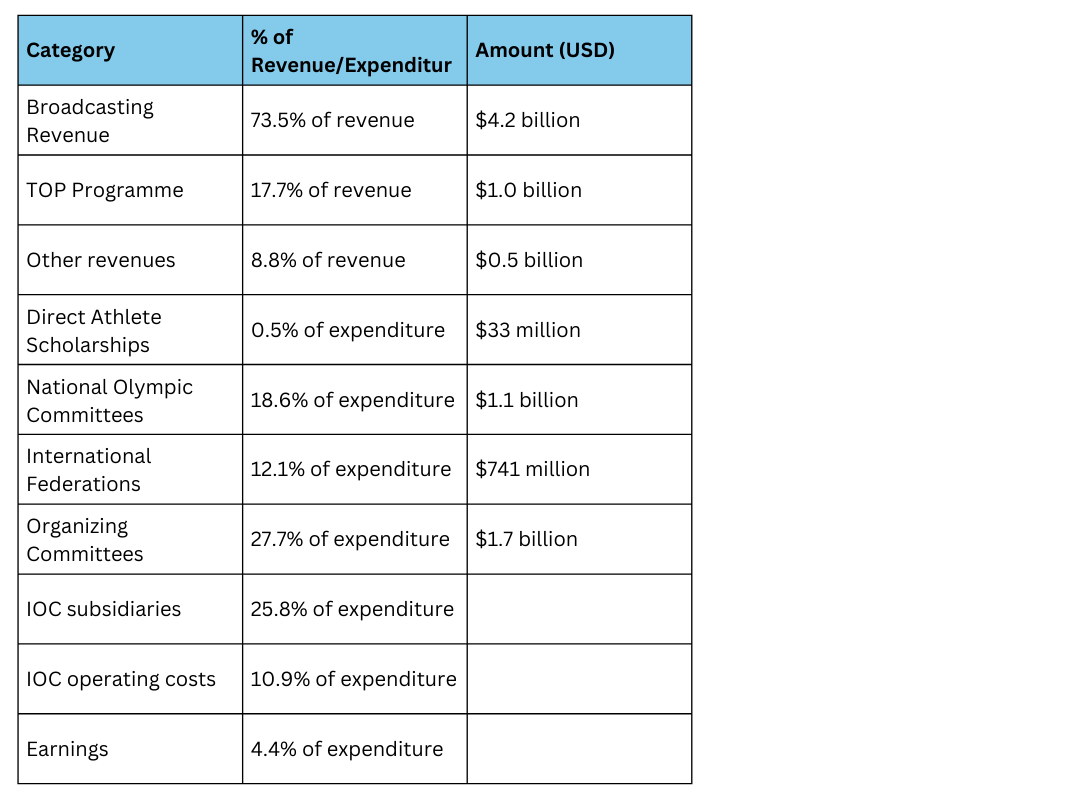
Source: Olympic Commercialization and Player Compensation: A Review of Olympic Financial Reports by The Ted Rogers School of Management in partnership with Global Athlete - April 2020
The most recent available financial accounts from the IOC from 2023 to 2024 suggest a similar trend in revenue versus expenditure. While further work needs to be done to review these current financials to gain a clearer and more open picture of the organization’s accounts, the below consolidated statement points towards a lack of clear revenue distribution to Olympic athletes. Adopting collective bargaining with even a modest redistribution of IOC revenue could yield meaningful benefits for both the athletes and the Games as a whole.
2023-2024 Consolidated Statement of Activities
In Thousands of US dollars (USD 000)
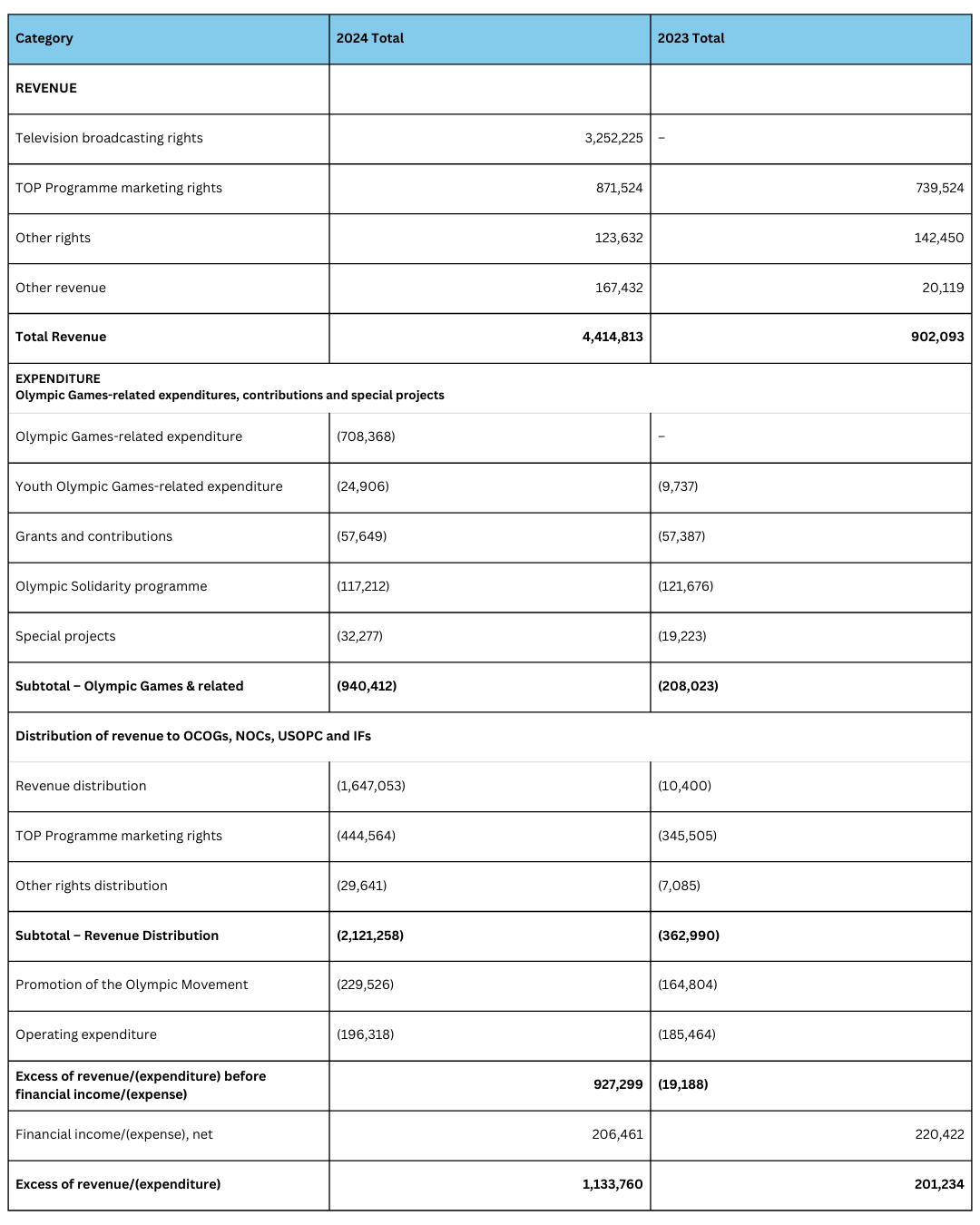
Source: International Olympic Committee, Lausanne, Report of the statutory auditor to the Session on the consolidated financial statements 2024. Page 7. https://stillmed.olympics.com/media/Documents/International-Olympic-Committee/Sessions/144th-IOC-Session/IOC-Consolidated-Financial-Statements-as-at-31-December-2024.pdf
SUMMARY
Collective bargaining would not weaken the IOC. Rather, it would legitimize and strengthen the IOC’s authority. Collective bargaining would modernize and stabilize the Olympic Movement. It would align it with contemporary governance standards and create a sustainable framework for fair athlete compensation that mirrors professional sport models, where athletes receive 40-60% of revenues.
To avoid long and binding legal battles as seen in the NCAA, it is time for proactive movement and thinking from the IOC to advance athletes’ position in the Olympic Movement. A proactive approach, where athletes are equal partners at the negotiating table, will allow the IOC to avoid public scrutiny because of legal challenges and discovery.
The IOC’s financial structure shows that athletes currently receive only a fraction of Olympic revenue despite being the central product driving its economic success. A collective bargaining agreement can strengthen the Olympic Brand, ensure athlete buy-in and provide the IOC with long-term stability. Even a modest revenue redistribution would make athletes partners in the IOC’s mission and bring the IOC closer to global sports governance best practices.
ENDS